The Practical Guide to RFID Asset Tracking
Every institution owns assets it cannot fully account for. Laptops issued to staff three years ago that nobody knows the current location of. Lab equipment that migrates between departments without documentation. Furniture purchased under a government grant that needs to be accounted for during audits but has scattered across campus buildings.
This is not negligence. It is the natural entropy of any organization with hundreds or thousands of physical assets and no reliable tracking infrastructure.
RFID changes this dynamic fundamentally, but only if implemented thoughtfully.
Why Barcodes Fall Short for Asset Management
Barcodes have been the default labelling system for assets for decades. They are cheap, simple, and universally understood. So why move beyond them?
The answer is operational friction. A barcode requires someone to physically find it on the asset (sometimes hidden under layers of dust or stuck in an inaccessible location), position a scanner correctly, and get a clean read. For a periodic audit of 5,000 assets spread across a 10-acre campus, this translates to weeks of manual labour.
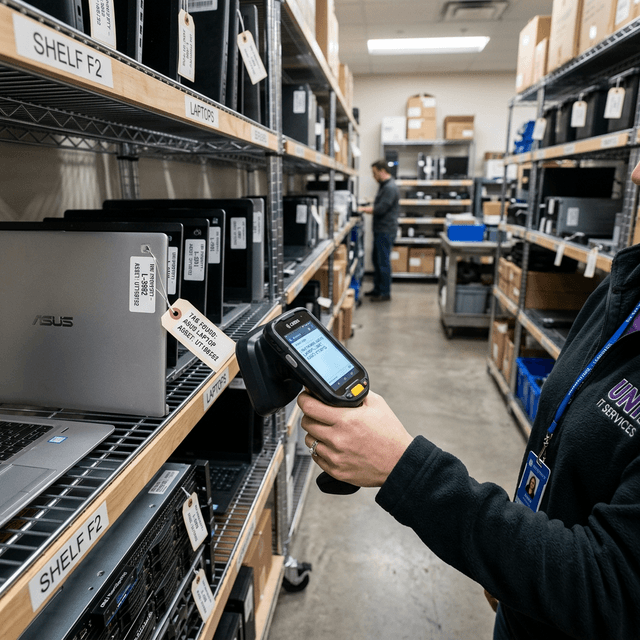
RFID tags, by contrast, can be read from a distance of several feet, through packaging and enclosures, without line-of-sight. A staff member walking through a building with a handheld reader can scan every tagged asset in every room without opening a single cabinet. The same 5,000-asset audit that took weeks now takes days — sometimes hours.
How RFID Asset Tracking Actually Works
The system has four components:
Tags are affixed to each asset. These are passive UHF tags for most applications — small, durable, and powered by the reader's radio signal so they never need batteries. For metal assets (which interfere with standard RFID), specialized on-metal tags are used.
Readers come in two forms. Fixed readers are installed at doorways and specific zones — they automatically detect when tagged assets enter or leave an area. Handheld readers are used for audits and searches — staff carry them while walking through spaces.
Middleware processes the raw data from readers, filtering duplicates, managing read events, and translating tag IDs into meaningful asset information.
Software provides the user interface — dashboards showing asset locations, audit reports, movement history, maintenance schedules, and alerts for unauthorized movement.
What to Expect in the First Six Months
We believe in setting realistic expectations. Here is what typically happens:
Month 1-2: Tagging and data entry. This is the least glamorous part. Every asset needs a tag, and every tag needs to be associated with the correct asset record in the database. For institutions that already have a comprehensive asset register, this is straightforward. For those that do not — and many do not — this phase doubles as a full physical verification exercise.
Month 3-4: System stabilization. Readers are calibrated, tag placements are adjusted based on real-world performance, and staff workflows are refined. There will be false reads, missed reads, and edge cases that need troubleshooting. This is normal and expected.
Month 5-6: Operational maturity. By this point, the system is producing reliable data. Audits that used to take weeks are completed in days. Management has real-time visibility into asset utilization. Maintenance alerts are triggering on schedule. The system is paying for itself.
Where RFID Asset Tracking Delivers the Most Value
Government and Grant-Funded Institutions
Any institution that receives government grants or donor funding faces audit requirements for assets purchased with those funds. Being able to produce a real-time, verifiable asset register — with location history and condition tracking — dramatically simplifies compliance. We have seen audit preparation time reduce from weeks to hours in institutions that adopt RFID tracking.
Healthcare Facilities
Medical equipment is expensive, mobile, and critical. A ventilator that cannot be located during an emergency is not just an inventory problem — it is a patient safety issue. RFID tracking in hospitals ensures that critical equipment is always locatable and that maintenance schedules are strictly followed.
Educational Campuses
Universities manage assets across multiple buildings, departments, and sometimes campuses. Lab equipment, IT hardware, library resources, sports equipment — the sheer volume and geographic spread makes manual tracking impractical. RFID provides a unified tracking layer across the entire institution.
Common Mistakes to Avoid
Skipping the asset register cleanup. RFID cannot fix bad data. If your asset register has duplicate entries, ghost assets (items that were disposed of but never removed from the register), or missing serial numbers, the RFID system will faithfully reflect that mess. Clean your data before you start tagging.
Choosing the wrong tag type. Not all RFID tags are equal. Tags designed for cardboard boxes will not work on metal surfaces. Tags rated for indoor use will fail outdoors within months. Matching the right tag to each asset category is essential and requires experience.
Ignoring the human element. Staff who interact with assets daily need to understand and trust the system. If they see it as a surveillance tool rather than an operational aid, adoption will suffer. Involve key stakeholders early and demonstrate how the system makes their work easier, not just management's oversight stricter.
The Bottom Line
RFID asset tracking is not a futuristic concept. It is a mature, proven technology deployed in thousands of institutions worldwide. The question is not whether it works — it does. The question is whether the implementation is designed around your specific operational reality rather than a generic template.
If your organisation struggles with asset visibility, audit compliance, or simply knowing where things are, a properly specified RFID tracking system will solve those problems. We are available to discuss what a deployment would look like for your specific situation.