Building a Digital Library in 2025: What Indian Institutions Need to Know
The term "digital library" gets thrown around in grant proposals, accreditation documents, and technology committee meetings with alarming casualness. Ask five different people what it means, and you will get five different answers. Some picture a room full of computers. Others imagine the complete elimination of physical books. Most are somewhere in between, uncertain about what is practical, what is aspirational, and what is simply marketing fluff.
Let us cut through the noise and talk about what building a digital library actually involves for an Indian educational institution in 2025.
Start With What "Digital Library" Actually Means
A digital library is not a replacement for physical books. It is a parallel infrastructure that provides:
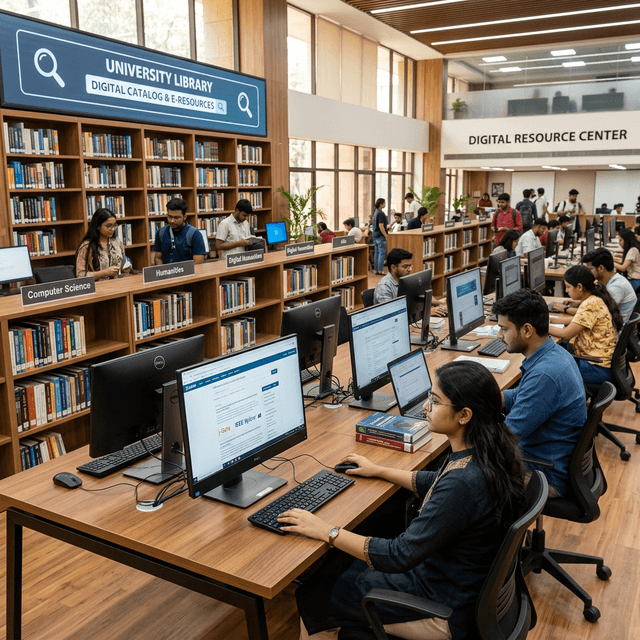
Digital access to resources — e-books, e-journals, databases, and digital archives that patrons can access from anywhere, not just within the library building.
Digital management of physical resources — using technology (RFID, integrated library management systems, analytics tools) to manage the physical collection more efficiently.
Digital services for patrons — online catalogues, self-service portals, mobile apps, remote access, and personalized recommendations.
A good digital library enhances the physical library; it does not replace it. The institutions getting the best results are those that invest in both dimensions simultaneously.
The Technology Stack That Actually Matters
Integrated Library Management System (ILMS)
This is the backbone. Whether you choose KOHA (open-source) or a commercial system like AutoLib or Libsys, the ILMS manages your catalogue, circulation, patron records, acquisitions, and serial management. Everything else connects to it.
For Indian institutions, KOHA has become increasingly popular because it eliminates licence fees, has strong community support, and is well-adapted to Indian library standards. But "free" is misleading — you still need implementation, customisation, training, and ongoing support, all of which cost money.
RFID Infrastructure
We have written extensively about RFID in libraries elsewhere on this blog, so we will not repeat that here. The short version: RFID is the most effective technology for bridging the physical and digital management of a library. Tags on physical books create a digital twin of your collection that can be tracked, audited, and managed in real time through software.
Digital Resource Platforms
Access to e-books and e-journals typically comes through institutional subscriptions — INFLIBNET's N-LIST and DELNET for Indian institutions, along with publisher-specific databases like JSTOR, IEEE, and Springer. These are not one-time purchases; they are recurring subscription costs that need to be budgeted annually.
Institutional Repository
This is often overlooked but increasingly important for accreditation. An institutional repository hosts the research output of your institution — theses, dissertations, conference papers, and faculty publications. DSpace and EPrints are the standard open-source options for Indian institutions.
Access and Discovery
A modern discovery layer — a Google-like search interface that searches across your physical catalogue, digital resources, and institutional repository simultaneously — dramatically improves how patrons find and use library resources. Open-source options like VuFind work well and integrate with KOHA.
Budgeting Honestly
Here is where most digital library plans fall apart. Institutions allocate budget for hardware and software but underestimate the ongoing costs that make the system actually work.
Year 1 costs include RFID hardware and tagging, server infrastructure, ILMS installation and customisation, staff training, and initial digital resource subscriptions. For a mid-sized university library, this typically ranges from ₹30 lakh to ₹1 crore depending on collection size and scope.
Annual recurring costs include ILMS support, digital resource subscriptions, RFID tag consumption (for new acquisitions), equipment maintenance, and staff training. Budget ₹5-15 lakh per year.
The cost most people forget is staff capacity. Implementing and running a digital library requires staff who understand both library science and technology. If your current team lacks these skills, you need to invest in training or hire accordingly. Technology without competent people to operate it is just expensive furniture.
The Phased Approach That Works
Trying to build a complete digital library in one go is a recipe for budget overruns and implementation fatigue. The institutions that succeed follow a phased approach:
Phase 1 (6-12 months): Foundation. Implement the ILMS, migrate existing catalogue data, clean up records, and establish basic digital services — online catalogue, patron portal, and RFID-based circulation.
Phase 2 (12-18 months): Expansion. Add digital resource subscriptions, set up the institutional repository, implement self-service kiosks, and deploy analytics dashboards.
Phase 3 (18-24 months): Optimization. Launch the discovery layer, implement mobile services, add advanced analytics, and explore emerging technologies like AI-powered recommendation engines.
Each phase delivers tangible value independently, so the library improves continuously rather than waiting for a "big bang" launch that may never come.
Common Pitfalls
Buying technology before defining requirements. We have visited institutions that purchased expensive RFID hardware two years before they had a functioning ILMS to connect it to. The hardware sat in boxes while the library continued operating on paper registers.
Ignoring data quality. Your digital library is only as good as your catalogue data. If the migration from the old system brings in duplicate records, missing fields, and inconsistent formatting, the new system will be frustrating to use from day one. Budget time and effort for data cleaning.
Underestimating change management. Library staff who have operated manual systems for decades need support in transitioning to digital workflows. This is not just training — it is addressing concerns, demonstrating value, and giving people time to build confidence with new tools.
The Opportunity
Indian higher education is undergoing a significant push toward digital infrastructure, driven by NEP 2020 requirements, NAAC accreditation criteria, and NIRF ranking parameters that specifically evaluate library and ICT capabilities.
For institutions that have not yet invested seriously in digital library infrastructure, this is both a challenge and an opportunity. The technology exists, the implementation playbooks are proven, and the operational benefits are well-documented. What is required is thoughtful planning, realistic budgeting, and committed execution.
If your institution is beginning this journey, we are here to help you navigate it — from initial assessment through full implementation. No pressure, no generic proposals — just practical advice grounded in real experience.