School Bus Safety in India: How RFID Tracking Gives Parents and Schools Peace of Mind
In 2019, a six-year-old child in Gurugram was left inside a school bus for hours after the driver and attendant failed to check the vehicle at the end of the route. The child survived, but the incident — one of several reported across Indian cities that year — highlighted a terrifying gap in school transportation safety.
School bus accidents, children boarding the wrong bus, kids not being picked up at the right stop, unauthorized individuals attempting to collect students — these are not hypothetical risks. They happen regularly, and they happen because most school transportation systems rely on human attention in environments where human attention inevitably lapses.
RFID-based student tracking does not eliminate human responsibility. But it adds an automated safety net that catches the failures that human attention misses.
How It Works in Practice
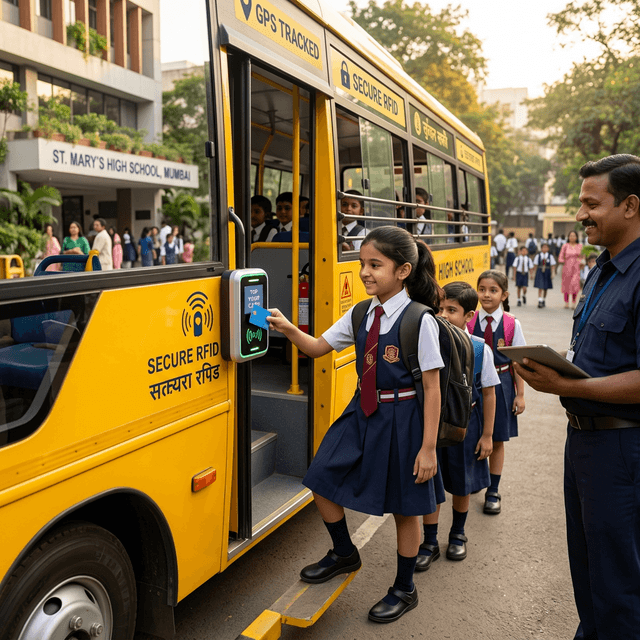
Each student carries an RFID card — the same card that might also serve as their school ID. RFID readers installed at the bus door register each student as they board and disembark.
When a student taps their card while boarding Bus 7 at the Rajiv Nagar stop at 7:23 AM, several things happen simultaneously:
- The student's identity is verified against the assigned bus route
- The parent receives an instant notification: "Aarav boarded Bus 7 at Rajiv Nagar, 7:23 AM"
- The school's transport dashboard updates in real time
- If the student boards the wrong bus, the system alerts both the bus attendant and the transport coordinator
When the student arrives at school and disembarks, another notification goes to the parent, and the school's attendance system registers their arrival.
At the end of the school day, the entire process repeats in reverse. If a student who boarded the bus in the morning has not been registered as disembarking at their stop, the system flags it immediately — not hours later when a parent calls in a panic.
The Problem of the "Last Check"
The most dangerous moment in school bus operations is the end of the route. The driver is supposed to walk through the bus and verify that no child has been left behind — the "last check." It is a simple task that takes 30 seconds. But when the driver has completed a long route in heavy traffic and is rushing to park the bus and begin the next task, that 30-second check sometimes does not happen.
RFID solves this with cold, unemotional logic. If the system shows that 23 students boarded the bus and only 22 were registered at their respective stops, the system alerts immediately. There is no "forgetting." There is no fatigue. The electronic count either matches or it does not.
GPS Integration: The Full Picture
RFID tracks students. GPS tracks the bus itself. Together, they provide a complete picture.
Parents can see, on a mobile app, exactly where their child's bus is on the route. Schools can monitor whether buses are following designated routes. Speed alerts trigger when a driver exceeds safe limits. Route deviations are flagged in real time.
For school administrators, this data also serves an operational purpose. Routes can be optimized based on actual traffic patterns and boarding/deboarding times. Bus utilization can be balanced. Driver performance can be objectively evaluated.
Addressing Privacy Concerns
Any tracking system raises legitimate privacy questions, especially when children are involved. The key principle we follow is data minimization — the system collects only what is needed for safety and operations.
Parents see their own child's data and nothing else. Schools see aggregate operational data for route management. Individual student tracking data is retained for a limited period and then purged. Access controls ensure that only authorized personnel can view sensitive information.
The system exists to answer two questions: "Is my child safe?" and "Are our buses operating correctly?" It is not designed for — and should not be used for — any purpose beyond these.
Implementation Realities for Indian Schools
Indian schools operate in diverse environments — from well-funded urban private schools to government schools with minimal infrastructure. RFID bus tracking needs to work across this spectrum, which means the system must be:
Robust against power and connectivity issues. Bus readers store data locally and sync when connectivity is available. Solar-powered readers eliminate dependency on the bus's electrical system.
Simple enough for drivers and attendants to use. The reader is automated — it processes cards as students walk past. Staff do not need to operate any interface during normal operation.
Affordable at scale. For a school running 20 buses, the per-bus cost of readers and installation needs to make financial sense alongside the already tight transportation budget.
Durable in Indian conditions. Dust, heat, rain, and the general wear-and-tear of a school bus environment. Equipment needs to survive years of daily use without frequent maintenance.
The Conversation That Matters
When we discuss bus tracking with school administrators, the most powerful moment is when they see the parent notification in action for the first time. "Aarav boarded Bus 7 at 7:23 AM." Five seconds later, the phone buzzes in the parent's pocket.
For a parent who drops their child at a bus stop every morning and spends the next 30 minutes hoping everything went smoothly, that notification is not just information. It is peace of mind.
That is what good technology should deliver. Not complexity. Not data overload. Just a simple answer to the question every parent asks: "Is my child safe?"
If your school is exploring student tracking solutions, we would welcome a conversation about what implementation would look like for your specific setup.